

While the Iranian war game naval exercises have been ongoing for almost five days, or half of the projected 10, tensions in the Straits of Hormuz region have been rising culminating with today's interchange between the head of the Iranian Navy and the US 5th Fleet (which for various reasons we can not present you with a status update today). One question that remains is just what would a closure of the Straits looks like. Luckily, the Middle East Media Research Institute's blog has caught a release by an Iranian website Mashreq News, which spells out the step by step details of just how such a closure would be enacted.
From MEMRI:
In response to threats by Western countries to impose oil sanctions on Iran, the Iranian website Mashreq News, which is close to Iranian military circles, posted an article on December 15, 2011 outlining military measures that could be taken by Tehran to close the Strait of Hormuz should the regime choose to do so.
The article enumerated the forces and weapons that Iran could employ in such a military operation, including fast attack craft carrying anti-ship missiles; submarines; battleships; cruise and ballistic missiles; bombers carrying laser-, radar- and optically-guided missiles; helicopters; armed drones; hovercraft; and artillery.
It stated that despite Iranian Supreme Leader Ali Khamenei's statements that Tehran would not initiate a military confrontation but would retaliate harshly if attacked, "there is no guarantee that [Tehran] will not launch a preemptory strike on the civilian level, for instance through cyber-warfare or by means of economic pressure, including by closing the Strait of Hormuz and cutting off [this] energy lifeline for an indefinite period of time." It added, "Should additional sanctions be imposed on Iran, especially in the domain of oil export, Iran might keep [its] oil from leaving its territorial waters."
In a further threat, the article stated that Iran would in the future be able to attack the 480-km pipeline with a capacity of 2.5 million barrels/day[1] that the UAE is planning to build in order to bypass the Strait of Hormuz in order to neutralize Iran's ability to disrupt the world's oil supply: "As for the plan... to construct a [pipeline] from the UAE that will be an alternative in times of emergency in case the Hormuz Strait is closed, we should note... that the entire territory of the UAE is within range of Iran's missiles, [so Iran] will easily be able to undermine security at the opening of this [pipeline] using weapons to be discussed this report."
In accordance with Iranian doctrine, the article pointed out that these weapons would actually not be necessary because there would be suicide operations, and added that "the faith of the Iranian youth, and their eagerness to sacrifice their lives, will sap the enemies' courage."
Despite statements by Iranian government spokesmen, including Oil Minister Rostam Qasemi and Foreign Ministry spokesman Ramin Mehmanparast, that the closing of the strait is not currently on Iran's agenda,[2] Majlis National Security Committee member Pervez Sarouri said that the Iran would be conducting 10 days of naval maneuvers, called "Velayat 90," beginning December 24, 2011, to drill closing it.[3]
 Satellite view of the Strait of Hormuz connecting the Persian Gulf to the Sea of Oman
Kayhan editor Hossein Shariatmadari, who is close to Khamenei, called on the regime to announce immediately that Tehran would close the strait to vessels from the U.S., Europe, Japan, or any other country participating in imposing oil sanctions on Iran.[4]
At a press conference on the subject of the Velayat 90 naval maneuvers, which commenced on December 24, Iranian Navy Commander Habibollah Sayyari said that his forces would be capable of closing the strait if asked to do so.[5]
It should be noted that Iranian officials have previously threatened to close the strait as a means of deterring Iran's neighbors and the West (see previous MEMRI reports from 2010, 2008 and 2007).[6]
The following are the main points of the Mashreq News article on closing the Strait of Hormuz.[7]

"In addition to their high speed and abovementioned equipment, these sea craft are highly maneuverable. Their ability to operate at night, aided by the requisite accessories, as well as in stormy weather, has been demonstrated repeatedly in recent years, in maneuvers both minor and major. Their successful record includes stopping submarines from countries beyond the [Gulf] region that aimed to cross the Strait of Hormuz, and supporting [Iranian] submarines threatened by enemy warships in the Indian Ocean... Iran has various types of naval mines, both stationary and remote controlled. This weapon [i.e. the mines] may, if necessary, be operated by Iranian boats and submarines [located at] various points in the Strait of Hormuz and the surrounding waters."
Submarines
The article continued: "The Iranian navy's acquisition of submarines... some 20 in number... has rendered it more powerful than the navies of the [other] countries in the region. Iran's submarine craft can use torpedoes, mines, and missiles, and can remain submerged for weeks in order to accomplish a mission. Apart from the Russian Kilo class submarines, the Nahang, Ghadir, and Fateh class submarines have been pre-fitted for the waters around Iran, especially the Persian Gulf... These submarines can remain stationary in the water and can evade various enemy radar and sonar systems...
"The Kilo class submarines can carry 24 mines or 18 large torpedoes, while the Fateh class submarines can carry 12 torpedoes and/or eight mines. In addition, there have been reports in the international media stating that Iran has equipped the Kilo class [submarines in its fleet] with Hoot torpedoes...
"The Ghadir class submarines can also successfully participate in the operation [to close the strait]... [These] are small submarines manned by one or several people. Known as 'wet submarines,' they are used for commando operations, laying mines, and firing torpedoes... and can operate in narrow and shallow areas."
Warships
The article stated that "Iran has various classes of missile ships, warships, and destroyers. These marine craft are capable of launching four 'Nour' anti-ship missiles, which have a range of 120-170 km, [even] over 200 km. Additionally, these warships' 114mm and 76mm guns... can threaten various [types of] ships. [Iran's] warships can [also] threaten submarines while simultaneously operating together with the rest of the [Iranian naval] force in closing the Strait of Hormuz."

Anti-Ship Cruise Missiles
It continued: "We divide Iran's missile force into two groups: cruise missiles and ballistic missiles. They possess a wide variety of ranges and destructive capabilities. Coastal launchers for Kowsar short-range missiles and for Nour and Ghadir missiles [with a range of some 200 km] have so far been displayed, and the Naser-1 medium-range missiles are launched from Qare'a triple-barrel missile launchers. These launchers are independent, meaning that if they are deployed near the coast, they could detect and identify naval targets and attack them without the need for supporting systems from [Iranian] air and naval units.
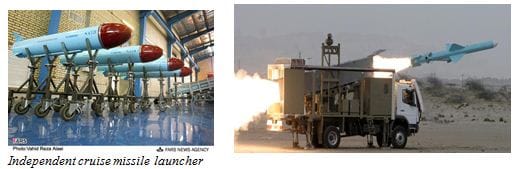
"These systems can cover most of the Strait of Hormuz if deployed and camouflaged 70 to 150 km deep into Iranian territory, or even in the Kerman province [in southeastern Iran]. The Iranian armed forces possess these systems in abundance, and they are ready for deployment."
Ballistic Missiles
The article noted: "...Thus far, three types of anti-ship ballistic missiles have been displayed in Iran: Khaleej-e Fars, Tondar, and Sejil. Khaleej-e Fars missiles, with a 300-km range and a 650-kg warhead, are designed to destroy enemy warships. The missile can be prepared for launch in a few minutes due to its use of solid fuel and advanced guidance systems. It strikes the enemy ships from above, traveling at Mach 3, reaching [the target] in a short time and at an acute angle.
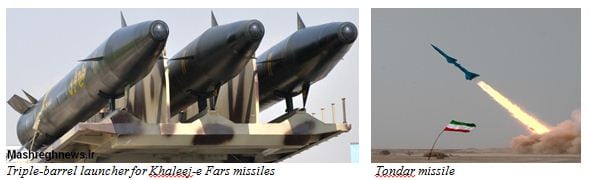
"The triple-barrel launcher for these missiles provides sufficient firepower from the first launch; it increases the operational effect of the missile, while decreasing the enemy's ability to retaliate. Based on photos of the missile, it uses an electronic guidance system, which ensures its effectiveness even against the enemy's electronic warfare. The missile's speed, angle of approach, and impact from above are effective points in its modus operandi. We can estimate that the enemy's chances of intercepting it are miniscule.
"The Tondar missile, whose range is estimated by experts to be 150-250 kilometers, operates alongside the Khaleej-e Fars missiles as a short range ballistic missile... and their combined operation can significantly raise the chances of hitting the target... The [Tondar] missile can cover the Straits of Hormuz from deep inside Iranian territory. The Khaleej-e Fars missile can cover the Western Sistan-Baluchestan area, the Kerman province area, eastern and southern Fars province, and all of the Straits of Hormuz."

"The most terrifying of all Iranian missiles is the Sejil long range missile. It has commonly been considered merely a surface-to-surface missile, but the armed forces recently announced that it can also be used to destroy naval targets. Although not much is known about the missile's guidance and targeting systems, the missile has shown great accuracy in hitting a predetermined target. This missile, with a range of 2,000 km, can reach speeds of Mach 8 to Mach 12 (2,700-4,100 meters per second)... Its warhead weighs at least 500 kilograms, helping it to destroy the target. This missile can be used to cover regions beyond the Strait of Hormuz even if deployed on the northern Iranian coast, or at the most distant point in northwest Iran. It is a two-stage rocket powered by solid fuel, and reaches great speed at the end of the first stage [of launch]. It is difficult for the enemy to detect and track it during the first stage, because it uses several methods to reduce its radar signature... Thanks to its high velocity, the chance of it being hit by enemy defense [systems] is even smaller than the chance that they will hit a Khaleej-e Fars missile.
"Such missiles would be launched from deep inside Iranian territory because scattering launchers over a larger area will make it difficult for the enemy to detect them, will limit the means the enemy will be able to use to destroy them, and will also allow the launchers to be relocated and re-camouflaged.
"Although the enemy is much more likely to detect lower-velocity missiles... the combination of the use of these weapons in areas both closer and farther away from the shore and the increased number of targets... can maintain their effectiveness."
Bomber Jets
The article stated: "Iranian fighter jets can carry various types of air-to-surface missiles that can operate against naval targets, including air-to-surface missiles with optical, laser, and radar guidance; Nour and Ghadir missiles adapted for aerial use; C-801K and C-802 missiles; as well as Kowsar and Naser missiles. [Iranian] Air Force jets can carry up to five such missiles.
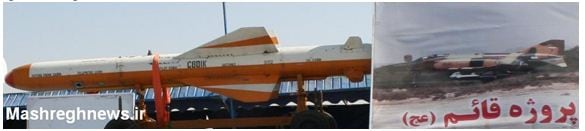
"Additional missiles for naval targets include: limited range TV-guided Maverick missiles; Qassad-1 and Qassad-2 optically guided bombs with a range of 30-50 kilometers (Qassad-3 bombs, with a range over 100 kilometers, will become operational soon); and Russian-made KH-25 and KH-29 missiles with laser and optical guidance, which can be mounted on Su-24, Su-25, and MiG-29 jets. Their range is 10km-30km, and they have medium destructive capabilities.
"In addition, KH-58 long-range anti-radar missiles, which can be mounted on Su-24 jets for attacks on enemy warships, will play an important role in closing the Strait of Hormuz.
"The array of missiles and bombs with varying ranges will assist Iran in operating remotely against enemy frigates and warships."
Helicopters
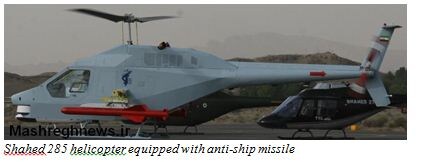
"The Shahed 285 helicopter can carry Kowsar anti-ship cruise missiles, and Mi-171 helicopters can launch Nour long range missiles, and apparently Ghadir missiles as well. These helicopters, along with Cobra attack helicopters, can threaten merchant vessels and enemy warships."
Flying Boats
"Only one model of flying boat has thus far become operational in Iran. In fact, it is a new type of plane that can land on the water, and can be equipped with anti-ship missiles. This boat can take off from the water, from various points on Iran's coast, and can operate against enemy warships together with aerial defense."

Drones
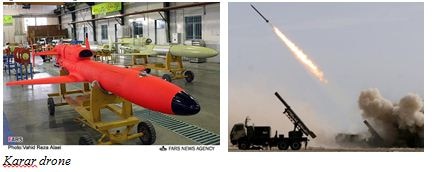
"The Iranian army drones are used for anti-ship missions. The Karar drone can carry four Kowsar missiles. Due to its speed, the drone can increase the potential energy of the missiles and extend their range. The drone has a range of some 1,000 km; it is launched by a rocket, and when it reaches the correct range, it launches the missiles. Karar drones can carry dozens of missiles to the enemy warships.
"The Karar drone is made from materials that allow it to evade radar detection and get close to enemy vessels. Nevertheless, the drone can also use missiles like Naser-1, for large areas."
Artillery and Surface-to-Sea Rocket Systems
The article also claimed that Iranian security officials several times pointed out that guided bombs are actually being used against moving naval targets. It said that the range of Iranian artillery shells is over 40 km, and that they can be used to harm or destroy enemy ships. It added that during maneuvers, Iran had successfully utilized the Fajr-3 and Fajr-5 rocket launchers against naval targets.
From MEMRI:
In response to threats by Western countries to impose oil sanctions on Iran, the Iranian website Mashreq News, which is close to Iranian military circles, posted an article on December 15, 2011 outlining military measures that could be taken by Tehran to close the Strait of Hormuz should the regime choose to do so.
The article enumerated the forces and weapons that Iran could employ in such a military operation, including fast attack craft carrying anti-ship missiles; submarines; battleships; cruise and ballistic missiles; bombers carrying laser-, radar- and optically-guided missiles; helicopters; armed drones; hovercraft; and artillery.
It stated that despite Iranian Supreme Leader Ali Khamenei's statements that Tehran would not initiate a military confrontation but would retaliate harshly if attacked, "there is no guarantee that [Tehran] will not launch a preemptory strike on the civilian level, for instance through cyber-warfare or by means of economic pressure, including by closing the Strait of Hormuz and cutting off [this] energy lifeline for an indefinite period of time." It added, "Should additional sanctions be imposed on Iran, especially in the domain of oil export, Iran might keep [its] oil from leaving its territorial waters."
In a further threat, the article stated that Iran would in the future be able to attack the 480-km pipeline with a capacity of 2.5 million barrels/day[1] that the UAE is planning to build in order to bypass the Strait of Hormuz in order to neutralize Iran's ability to disrupt the world's oil supply: "As for the plan... to construct a [pipeline] from the UAE that will be an alternative in times of emergency in case the Hormuz Strait is closed, we should note... that the entire territory of the UAE is within range of Iran's missiles, [so Iran] will easily be able to undermine security at the opening of this [pipeline] using weapons to be discussed this report."
In accordance with Iranian doctrine, the article pointed out that these weapons would actually not be necessary because there would be suicide operations, and added that "the faith of the Iranian youth, and their eagerness to sacrifice their lives, will sap the enemies' courage."
Despite statements by Iranian government spokesmen, including Oil Minister Rostam Qasemi and Foreign Ministry spokesman Ramin Mehmanparast, that the closing of the strait is not currently on Iran's agenda,[2] Majlis National Security Committee member Pervez Sarouri said that the Iran would be conducting 10 days of naval maneuvers, called "Velayat 90," beginning December 24, 2011, to drill closing it.[3]
Satellite view of the Strait of Hormuz connecting the Persian Gulf to the Sea of OmanKayhan editor Hossein Shariatmadari, who is close to Khamenei, called on the regime to announce immediately that Tehran would close the strait to vessels from the U.S., Europe, Japan, or any other country participating in imposing oil sanctions on Iran.[4]
At a press conference on the subject of the Velayat 90 naval maneuvers, which commenced on December 24, Iranian Navy Commander Habibollah Sayyari said that his forces would be capable of closing the strait if asked to do so.[5]
It should be noted that Iranian officials have previously threatened to close the strait as a means of deterring Iran's neighbors and the West (see previous MEMRI reports from 2010, 2008 and 2007).[6]
The following are the main points of the Mashreq News article on closing the Strait of Hormuz.[7]
Fast Attack Craft
The article stated that since it first introduced fast attack craft for use in the Iran-Iraq war (1980-1988), the Iranian navy has immeasurably improved the craft's "ability to face advanced enemy combat vessels, much less cargo ships. These boats are equipped with sea radar systems; advanced electronic communication systems; sea-to-sea cruise missiles, both short-range – 25 km – and medium range; medium- and large-caliber [sic] torpedoes; and naval mines, along with traditional means of warfare – including semi-heavy machine guns, missile launchers, and shoulder-launched anti-aircraft missiles. These sea craft are capable of blocking the Strait [of Hormuz] for a brief or an extended period, and of facing enemy warships trying to open the route."In addition to their high speed and abovementioned equipment, these sea craft are highly maneuverable. Their ability to operate at night, aided by the requisite accessories, as well as in stormy weather, has been demonstrated repeatedly in recent years, in maneuvers both minor and major. Their successful record includes stopping submarines from countries beyond the [Gulf] region that aimed to cross the Strait of Hormuz, and supporting [Iranian] submarines threatened by enemy warships in the Indian Ocean... Iran has various types of naval mines, both stationary and remote controlled. This weapon [i.e. the mines] may, if necessary, be operated by Iranian boats and submarines [located at] various points in the Strait of Hormuz and the surrounding waters."
Submarines
The article continued: "The Iranian navy's acquisition of submarines... some 20 in number... has rendered it more powerful than the navies of the [other] countries in the region. Iran's submarine craft can use torpedoes, mines, and missiles, and can remain submerged for weeks in order to accomplish a mission. Apart from the Russian Kilo class submarines, the Nahang, Ghadir, and Fateh class submarines have been pre-fitted for the waters around Iran, especially the Persian Gulf... These submarines can remain stationary in the water and can evade various enemy radar and sonar systems...
"The Kilo class submarines can carry 24 mines or 18 large torpedoes, while the Fateh class submarines can carry 12 torpedoes and/or eight mines. In addition, there have been reports in the international media stating that Iran has equipped the Kilo class [submarines in its fleet] with Hoot torpedoes...
"The Ghadir class submarines can also successfully participate in the operation [to close the strait]... [These] are small submarines manned by one or several people. Known as 'wet submarines,' they are used for commando operations, laying mines, and firing torpedoes... and can operate in narrow and shallow areas."
Warships
The article stated that "Iran has various classes of missile ships, warships, and destroyers. These marine craft are capable of launching four 'Nour' anti-ship missiles, which have a range of 120-170 km, [even] over 200 km. Additionally, these warships' 114mm and 76mm guns... can threaten various [types of] ships. [Iran's] warships can [also] threaten submarines while simultaneously operating together with the rest of the [Iranian naval] force in closing the Strait of Hormuz."
Anti-Ship Cruise Missiles
It continued: "We divide Iran's missile force into two groups: cruise missiles and ballistic missiles. They possess a wide variety of ranges and destructive capabilities. Coastal launchers for Kowsar short-range missiles and for Nour and Ghadir missiles [with a range of some 200 km] have so far been displayed, and the Naser-1 medium-range missiles are launched from Qare'a triple-barrel missile launchers. These launchers are independent, meaning that if they are deployed near the coast, they could detect and identify naval targets and attack them without the need for supporting systems from [Iranian] air and naval units.
"These systems can cover most of the Strait of Hormuz if deployed and camouflaged 70 to 150 km deep into Iranian territory, or even in the Kerman province [in southeastern Iran]. The Iranian armed forces possess these systems in abundance, and they are ready for deployment."
Ballistic Missiles
The article noted: "...Thus far, three types of anti-ship ballistic missiles have been displayed in Iran: Khaleej-e Fars, Tondar, and Sejil. Khaleej-e Fars missiles, with a 300-km range and a 650-kg warhead, are designed to destroy enemy warships. The missile can be prepared for launch in a few minutes due to its use of solid fuel and advanced guidance systems. It strikes the enemy ships from above, traveling at Mach 3, reaching [the target] in a short time and at an acute angle.
"The triple-barrel launcher for these missiles provides sufficient firepower from the first launch; it increases the operational effect of the missile, while decreasing the enemy's ability to retaliate. Based on photos of the missile, it uses an electronic guidance system, which ensures its effectiveness even against the enemy's electronic warfare. The missile's speed, angle of approach, and impact from above are effective points in its modus operandi. We can estimate that the enemy's chances of intercepting it are miniscule.
"The Tondar missile, whose range is estimated by experts to be 150-250 kilometers, operates alongside the Khaleej-e Fars missiles as a short range ballistic missile... and their combined operation can significantly raise the chances of hitting the target... The [Tondar] missile can cover the Straits of Hormuz from deep inside Iranian territory. The Khaleej-e Fars missile can cover the Western Sistan-Baluchestan area, the Kerman province area, eastern and southern Fars province, and all of the Straits of Hormuz."
"The most terrifying of all Iranian missiles is the Sejil long range missile. It has commonly been considered merely a surface-to-surface missile, but the armed forces recently announced that it can also be used to destroy naval targets. Although not much is known about the missile's guidance and targeting systems, the missile has shown great accuracy in hitting a predetermined target. This missile, with a range of 2,000 km, can reach speeds of Mach 8 to Mach 12 (2,700-4,100 meters per second)... Its warhead weighs at least 500 kilograms, helping it to destroy the target. This missile can be used to cover regions beyond the Strait of Hormuz even if deployed on the northern Iranian coast, or at the most distant point in northwest Iran. It is a two-stage rocket powered by solid fuel, and reaches great speed at the end of the first stage [of launch]. It is difficult for the enemy to detect and track it during the first stage, because it uses several methods to reduce its radar signature... Thanks to its high velocity, the chance of it being hit by enemy defense [systems] is even smaller than the chance that they will hit a Khaleej-e Fars missile.
"Such missiles would be launched from deep inside Iranian territory because scattering launchers over a larger area will make it difficult for the enemy to detect them, will limit the means the enemy will be able to use to destroy them, and will also allow the launchers to be relocated and re-camouflaged.
"Although the enemy is much more likely to detect lower-velocity missiles... the combination of the use of these weapons in areas both closer and farther away from the shore and the increased number of targets... can maintain their effectiveness."
Bomber Jets
The article stated: "Iranian fighter jets can carry various types of air-to-surface missiles that can operate against naval targets, including air-to-surface missiles with optical, laser, and radar guidance; Nour and Ghadir missiles adapted for aerial use; C-801K and C-802 missiles; as well as Kowsar and Naser missiles. [Iranian] Air Force jets can carry up to five such missiles.
"Additional missiles for naval targets include: limited range TV-guided Maverick missiles; Qassad-1 and Qassad-2 optically guided bombs with a range of 30-50 kilometers (Qassad-3 bombs, with a range over 100 kilometers, will become operational soon); and Russian-made KH-25 and KH-29 missiles with laser and optical guidance, which can be mounted on Su-24, Su-25, and MiG-29 jets. Their range is 10km-30km, and they have medium destructive capabilities.
"In addition, KH-58 long-range anti-radar missiles, which can be mounted on Su-24 jets for attacks on enemy warships, will play an important role in closing the Strait of Hormuz.
"The array of missiles and bombs with varying ranges will assist Iran in operating remotely against enemy frigates and warships."
Helicopters
"The Shahed 285 helicopter can carry Kowsar anti-ship cruise missiles, and Mi-171 helicopters can launch Nour long range missiles, and apparently Ghadir missiles as well. These helicopters, along with Cobra attack helicopters, can threaten merchant vessels and enemy warships."
Flying Boats
"Only one model of flying boat has thus far become operational in Iran. In fact, it is a new type of plane that can land on the water, and can be equipped with anti-ship missiles. This boat can take off from the water, from various points on Iran's coast, and can operate against enemy warships together with aerial defense."
Drones
"The Iranian army drones are used for anti-ship missions. The Karar drone can carry four Kowsar missiles. Due to its speed, the drone can increase the potential energy of the missiles and extend their range. The drone has a range of some 1,000 km; it is launched by a rocket, and when it reaches the correct range, it launches the missiles. Karar drones can carry dozens of missiles to the enemy warships.
"The Karar drone is made from materials that allow it to evade radar detection and get close to enemy vessels. Nevertheless, the drone can also use missiles like Naser-1, for large areas."
Artillery and Surface-to-Sea Rocket Systems
The article also claimed that Iranian security officials several times pointed out that guided bombs are actually being used against moving naval targets. It said that the range of Iranian artillery shells is over 40 km, and that they can be used to harm or destroy enemy ships. It added that during maneuvers, Iran had successfully utilized the Fajr-3 and Fajr-5 rocket launchers against naval targets.
Endnotes:
[1] Reuters.com, November 21, 2011
[2] Sharq (Iran), December 15, 2011; ISNA (Iran), December 14, 2011. An article on the Mardomak website, which is operated from outside Iran, stated that the closing of the strait was an empty threat: "As long as Iran's economy is dependent upon oil, and the export of crude oil passes through the Persian Gulf, the closing of the Strait of Hormuz will remain [nothing but] a verbal threat... Even if the tension between Iran and the U.S. increases considerably, the closing of the strait will not be an option. Iran will respond to the pressure by other means." Mardomak.org, December 22, 2011.
[3] Fars (Iran), December 13, 2011. The oil minister denied reports that Iran plans to close the strait as part of the exercise. Mashreq News (Iran), December 16, 2011.
[4] Kayhan (Iran), December 13, 2011. In addition, a group of Majlis members circulated a petition defending Iran's right to close the strait in response to oil sanctions. Kayhan (Iran), December 19, 2011.
[5] Yjc.ir, December 22, 2011.
[6] See MEMRI Inquiry and Analysis No. 615, "Iran Demonstrates Its Deterrent Strength in Military Maneuvers," June 14, 2010, http://www.memri.org/report/en/0/0/0/0/0/0/4372.htm; MEMRI Special Dispatch No. 2029, "Iran Threatens to Close Strait of Hormuz If Attacked," August 19, 2008, http://www.memri.org/report/en/0/0/0/0/0/0/2842.htm; MEMRI Inquiry and Analysis No. 407, "Iran's Response to Western Warnings: 'First Strike,' 'Preemptive Attack,' Long-Range Ballistic Missiles, 'Asymmetric [Guerilla] Warfare,'" November 28, 2007, http://www.memri.org/report/en/0/0/0/0/0/0/2465.htm .
[7] Mashreq News (Iran), December 15, 2011.
Similar Articles You Might Enjoy:
- Iran Military Practicing Straits Of Hormuz Closure
- US Navy Says Any Disruption To Straits Of Hormuz "Will Not Be Tolerated"
- Update: It's Not On Just Yet: Iran Denies Earlier Reports:... Iran Closes Straits Of Hormuz, Oil Explodes
- Iran Launching "Massive" Ten Day War Game Tomorrow In Close Proximity To CVN-74 John Stennis
- Iran Moves Forces To War Alert


http://www.israelnationalnews.com/News/News.aspx/151128#.TvtfitTLy5J
Iran says it chased away a Western helicopter that approached its navy war games area and did not leave until three warnings were issued.
Yesterday, a chopper which belonged to the trans-regional countries tried to approach the region of Velayat 90 exercises, but it left the area when it received a serious warning after it ignored two other warning signals of our units," Lieutenant Commander of the Iranian Navy Admiral Seyed Mahmoud Moussavi said.
Gulf of Tonkin all over again, watch some US helicopter get shot down after going into their war zones airspace and that'll be the excuse for launching a war against Iran. The US is already trying really hard to make Iran launch a war on the US by all the massive sanctions. Get Fox news back on to herd the sheple saying all Iranians are crazy terrorists and Iran has nukes and we're set for go. It's coming folks, war with Iran. Obama will proudly proclaim that we're winning the war on terror and we'll go out killing shepards in Iran so we can get their oil. (Hey maybe he'll get re-elected!) It's super-happy-keynesianism fun times.
It's been a while since the US has been empire building, Iraq was such a long time ago. What better way is there to start a massive spending program than launch full out war? Then we can inflate away all America's problems.
It's Time to start that oil crisis portfolio: Oil names (XOM, PBR etc), Ethanol (PEIX,BIOF), Defence Names (LMT, BA, NOC).
Besides that, Americans are a bunch of stupid animals easy to manipulate and subdue. The psychological impact of this event will elicit the brute and ignorant populace to demand a massive retaliation against the alleged perpetrators (explicitly Iran); the Obama administration will need the unconditional support of these mules in order to further their agenda.
Absent of this essential prerequisite (a false flag operation), President Soetoro won't be able to persuade US Congress to issue a formal declaration of war.
I'd surrender straight away.
US subs are what would destroy all other world Navies including the rotting Russian Fleet; Japan has some comparable power. Subs, US subs win all scenarios. Its the ultimate gurilla style force... running it now on janes fleet command; US wins, only costs 3 more trillion dollars and we fall apart like the USSR; all political prisoners in the USSA gulag are set free including Ron Paul; Emperor Obama is deposed...
I did like their 'flying boat'...they mated a plane to an aluminum rowboat, judging from the hull.
"It won't take weeks. You know that, professor. Our military machine will crush Iraq in a matter of days and there's no question that it will."
(Fox News Channel's Bill O'Reilly, 2/10/03)
Where are the photos and details of the American forces in the region?
Come on ZH...Iran isn't exactly a titan of military might. Keep it realistic, please.
/sarc off?
The US Military has always been the bitch of bleeding heart liberal commie faggots; I'll let them know you said so.
that we we suck royally at; mainly because it doesnt work... it fails everytime; unless its against the nazi's, imperial Japan, or cold war russians... Never start a land war in eurasia...bottom line here...unless its about black gold and peak cheap oil, that is running low...
They were actually referred to as 'weapons of mass delusion' but then Reuters got it wrong and it was never corrected.
And we are going to need those Tico class which are recieving the anti ballistic missile for playtime when the time comes.
Nuclear powered, remember.
During the 2006 Lebanon War, the vessel was patrolling in Lebanese waters ten nautical miles off the coast of Beirut. It was damaged on July 14, 2006 on the waterline, under the aft superstructure [1][2] by a missile (likely a Chinese-designed C-802[3]) fired by Hezbollah. Reportedly, setting the flight deck on fire and crippling the propulsion systems inside the hull.[4] However, INS Hanit stayed afloat, got itself out of the line of fire, and made the rest of the journey back to Ashdod for repairs on its own.[5] Four crew members were killed during the attack: Staff Sergeant Tal Amgar, Corporal Shai Atas, Sergeant Yaniv Hershkovitz, and First Sergeant Dov Steinshuss.[6]
According to the Israeli Navy, the ship's sophisticated automatic missile defense system was not deployed, even though the early warning system is usually deployed during peace-time wargames. Israel said the defense system was not deployed because of Israeli aircraft in the area.
http://en.wikipedia.org/wiki/INS_Hanit
It does allow for great overhead optics for those "terrifying" Iranian subs though ;-)
Even then price of a new bike would be out of reach for most people at that point. Bike thefts would sky rocket.
Boarding houses would come back for the out of town worker.
Most people would get used to three things. Rolling black outs like Pakistan, India and Greece are going to become regular occurances. Last summer was the last time you used Air conditioning for the rest of your life and heat is either too hot or non-existent.
Medical: long term care and machines to keep people on life support will require seperate insurance in addition to the regular health insurance regardless of country. Keeping a generator running to dodge the rolling blackouts and the patient alive will be expensive.
Unscheduled blackouts: People will move to installing base board heating en masse to avoid oil furnace prices. This strains the 80 year old electrical infrastructure to breaking many times during the winter. Many freeze to death in the night peacefully to hypotherma, entire families are uncovered (like England right now) huddled and frozen together in their suburbanite homes.
Government acts to stop blackouts by placing a ban on AC globally. First heat wave, the elderly homes suffer 10% mortality rate, all paliative care patients die of heat stroke, by the end of the summer elderly deaths are identified by the smell coming from homes.
Could happen that way...never know.
They can also get China and/or Russia to become more hostile toward the US and EU either economically or through covert military support. These are all bigger problems than the weapons Iran has which seemed to be the point of the post.
****
Oh yeah, they're totally farmers and sheep herders with pitchforks.
The more I think about it, western pride is quickly becoming one of our greatest weaknesses.
I am not saying the US military couldnt destroy Iran given time and resources, I am saying most people severely under estimate what a barrage of sophisticated weapons would to our interests and assets in the area.
It is not beyond reality to think every US naval asset in the persian gulf could be wiped out by such missiles and unorthodox/alternative warefare tactics.
Not to mention allies and assets in Iraq, Israel, Saudi Arabia, UAE, etc etc.
This is not Iraq or Afganistan, Iran is more technologically sophisticated than most westerners give them credit for and unfortunately our arrogance will lead to an explosive conflict from which there is no going back.
is the issue territorial landmass, borders, and waterway security OR being a bully?
Naw, they're just fucking nuts with suicidal tendencies.
Apparently they have only now recovered from it.
They were told to stop playing on the calls and get back to work.
At the time of Pearl Harbor, it was a Generation who understood total war. A war that will essentially eliminate a Nation State and the two atomic attacks did that. Even while a million plus invasion was scheduled for winter.
We are still handing out Purple Hearts massed up into stockpiles for that '45 invasion.
Sadly, I fear this Nation as a People no longer knows what it is to commit to war in it's totality and are willing to accept the required sacrifices to make it happen.
But on Ebay, they go for 120$ a piece!
How about this: Nuke the entire middle east. The oil is underground and can be recovered once the human vermin have been eradicated and it will automatically lower everyone's carbon footprint for about 5 years.
This war will generate a lot of quality television which will be great for commercial revenue thus boosting the economy!
SLBM MIRV 8 simple letters. 1 simple solution. Let's get going on this already.